Crypto Capital Gains Tax Rates 2025 and 2026, Explained With Worked Examples
In the US, crypto you sell, swap or spend after holding it for more than a year is taxed at the long-term capital gains rates of 0%, 15% or 20%, depending on your taxable income. Crypto held for a year or less is taxed as ordinary income, at federal rates from 10% to 37%. Higher earners can owe an extra 3.8% net investment income tax, and many states add their own tax. For 2026, a single filer pays 0% on long-term gains that fit under $49,450 of total taxable income, according to IRS Revenue Procedure 2025-32. This page sets out the 2025 and 2026 brackets from IRS sources and walks through four calculations line by line. It is general information for US federal tax, checked on 9 October 2026, not tax advice; your own figures belong with a tax professional.
Short answer: 0%, 15% or 20% long-term; your income rate short-term
Crypto is property for US tax purposes. The IRS first said so in Notice 2014-21 and its digital-assets page still treats it that way. So the gain on each disposal is the dollar value you received minus your cost basis, and the rate depends on two things:
- How long you held it. More than one year is long-term; one year or less is short-term. IRS Topic 409 sets the line.
- Your taxable income for the year, with the gain included. Long-term gains are taxed in their own 0%, 15% and 20% bands; short-term gains are simply added to your ordinary income.
Disposal is broader than cashing out: swapping one coin for another and paying for something with crypto are disposals too. Income events such as staking rewards are different again: they are taxed as ordinary income when received, and only produce a capital gain or loss when you later dispose of those coins. Our explainer on how crypto is taxed sets the two side by side.
2025 and 2026 long-term capital gains brackets
The thresholds below are the top of each band in total taxable income, which means income after deductions, including the gain. The 2025 figures apply to returns filed in 2026; the 2026 figures apply to the tax year you are in now and to returns filed in 2027.
| Filing status | 0% up to (2025) | 15% up to (2025) | 0% up to (2026) | 15% up to (2026) |
|---|---|---|---|---|
| Single | $48,350 | $533,400 | $49,450 | $545,500 |
| Married filing jointly | $96,700 | $600,050 | $98,900 | $613,700 |
| Head of household | $64,750 | $566,700 | $66,200 | $579,600 |
| Married filing separately | $48,350 | $300,000 | $49,450 | $306,850 |
Taxable income is what is left after the standard or itemised deduction. The standard deduction for 2026 is $16,100 for single filers, $32,200 for married couples filing jointly and $24,150 for heads of household. For 2025 it is $15,750, $31,500 and $23,625, the amounts as raised by the 2025 tax law; older articles still quote the superseded $15,000 and $30,000.
Short-term gains: the 2026 ordinary income brackets
Short-term gains are not taxed at a special rate. They are added to your wages and other ordinary income and taxed through the normal brackets, so the rate depends on which band the gain lands in.
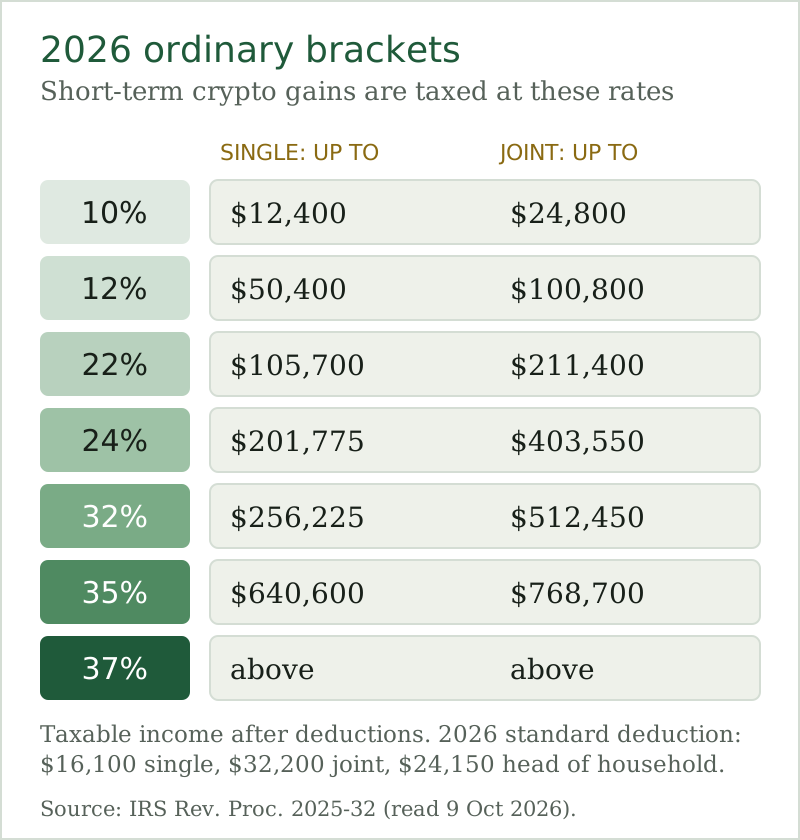
For 2025 returns, the single-filer bands top out at $11,925 (10%), $48,475 (12%), $103,350 (22%), $197,300 (24%), $250,525 (32%) and $626,350 (35%), with 37% above, per Rev. Proc. 2024-40. For married couples filing jointly the 2025 tops are $23,850, $96,950, $206,700, $394,600, $501,050 and $751,600.
How to calculate your crypto tax, step by step
Whether you use software or a pencil, the federal calculation follows the same order. Gains stack on top of your other income, which is why the same profit can be taxed at different rates for different people.
- Start with taxable ordinary income: wages and other income, minus your deduction.
- Add net short-term gains to it. They are taxed at your ordinary rates.
- Stack net long-term gains on top. Whatever part of them sits below the 0% threshold is taxed at 0%; the part between the 0% and 15% thresholds at 15%; anything above at 20%.
- Check the 3.8% net investment income tax if your modified adjusted gross income is above $200,000 (single or head of household), $250,000 (married filing jointly) or $125,000 (married filing separately).
Worked examples 1 to 4
These use invented, round numbers, 2026 federal rates only, and no credits or other deductions. Each starts from taxable income, so the standard deduction has already been taken off.
Example 1: the same $10,000 gain, held 11 months or 13 months. A single filer has $30,000 of taxable income before a $10,000 crypto gain. If they sold after 11 months, the gain is short-term and lands between $30,000 and $40,000, entirely in the 12% band: $1,200 of tax. If they waited until 13 months, the gain is long-term, and because $40,000 is still under the $49,450 threshold, the whole gain is taxed at 0%: no federal tax on it at all.
Example 2: a gain that straddles the 0% line. A single filer has $45,000 of taxable income and a $10,000 long-term gain. The first $4,450 of the gain fills the space up to $49,450 and is taxed at 0%. The remaining $5,550 is taxed at 15%, which is $832.50. Their effective rate on the gain is about 8.3%.
Example 3: a married couple. A couple filing jointly has $120,000 of taxable income and a $20,000 gain. Held more than a year, all of it sits above the $98,900 threshold and is taxed at 15%: $3,000. Sold short-term instead, it lands in the 22% band (which runs to $211,400 for joint filers): $4,400.
Example 4: a high earner and the NIIT. A single filer has $250,000 of taxable income and a $10,000 gain. Short-term, the first $6,225 is taxed at 32% (up to $256,225) and the remaining $3,775 at 35%: $3,313.25. Long-term, it is all at 15%: $1,500. On top of either, their modified adjusted gross income is now well above $200,000, so the 3.8% net investment income tax applies to the $10,000 gain: another $380.
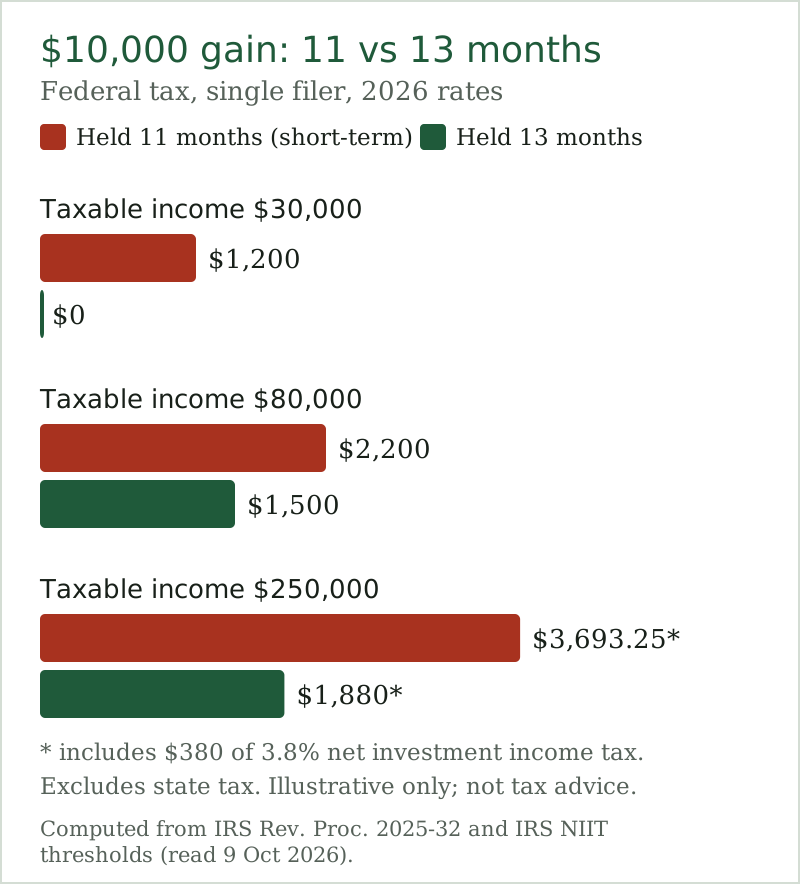
The chart adds a middle case. At $80,000 of taxable income, the 11-month sale costs $2,200 (22%) and the 13-month sale $1,500 (15%). Across the three incomes, waiting past the one-year line saves $1,200, $700 and $1,813.25. That is not advice to hold any coin: prices move, and a tax saving can be wiped out by a fall in value. It only shows why the date on each lot matters.
The 3.8% NIIT and state taxes
The net investment income tax is a separate 3.8% federal tax. According to the IRS, it applies to the lesser of your net investment income or the amount by which your modified adjusted gross income exceeds $200,000 for single filers and heads of household, $250,000 for married couples filing jointly, or $125,000 for married filing separately. Crypto gains count as investment income, and the IRS says these thresholds are not indexed for inflation, so more people cross them each year. For a high earner, that makes the top federal rate on long-term gains 23.8% and on short-term gains 40.8%.
State income tax can sit on top of all of this, and the rules vary widely from state to state. Check your state revenue department's own guidance, because federal software defaults do not always capture it.
Holding period and cost basis: the one-year line
The holding period runs from when you acquire a coin to when you dispose of it, and long-term treatment needs more than one year. Every purchase is its own lot with its own clock, so a single sale can contain both short-term and long-term pieces if you bought at different times.
Your cost basis is what you paid, including fees. When you sell part of a holding, a lot-identification method decides which units you sold. First in, first out (FIFO) is the default; specific identification is allowed when your records clearly show which units went. Since 1 January 2025, under IRS Revenue Procedure 2024-28, those rules apply wallet by wallet and account by account, not across one universal pool, and the procedure set a safe harbour for allocating basis to each wallet as of that date. Our guide to Form 1099-DA and broker reporting explains how exchanges now report sales to the IRS.
How losses change the math
Gains and losses are netted before any rate applies. Short-term results are combined with each other, long-term with each other, and then the two totals are set against each other. If the year ends in a net loss, IRS Topic 409 lets you deduct up to $3,000 of it against other income ($1,500 if married filing separately) and carry the rest forward to future years.
Here is a quick case. You realise an $8,000 short-term loss and no gains. You deduct $3,000 this year and carry $5,000 forward. Next year you realise a $5,000 long-term gain; the carried-forward loss cancels it, so there is no tax on that gain. Losses are therefore worth recording carefully, and our guide to crypto losses and tax-loss harvesting covers the legal ways people use them.
Edge cases that change which rate applies
A few situations trip people up because they do not look like selling.
Swaps and spending. Trading one coin for another, or paying for something in crypto, disposes of the coin you gave up. You have a gain or loss on it measured in dollars at that moment, and the value becomes the cost basis of whatever you received.
Rewards you later sell. Staking rewards are ordinary income at their fair market value when you gain control of them, under IRS Revenue Ruling 2023-14. That value becomes their basis, and their holding period starts then, so selling them within a year produces a short-term result even if the original staked coins are years old.
Moving coins between your own wallets. The IRS virtual-currency FAQ says a transfer between wallets or accounts you own is not taxable, even if you receive an information return about it. The coins keep their original basis and purchase date.
Coins from a hard fork. The same FAQ treats new coins received after a hard fork as ordinary income at their fair market value in the year you receive them.
Stablecoins. Selling or swapping a dollar stablecoin is still a disposal, but because its value barely moves, the gain or loss is usually tiny. It still belongs in your records.
UK readers: capital gains tax on crypto
In the UK the system is different. According to HMRC, you may owe capital gains tax when you dispose of cryptoassets by selling them, exchanging them for another cryptoasset, using them to pay for goods or services, or giving them away. Gains above the annual exempt amount of £3,000 (for 2025/26 and 2026/27) are taxed at 18% within your basic-rate band and 24% above it. Tokens of the same type are pooled for cost purposes, with special same-day and 30-day matching rules. For example, assuming the whole gain sits in the higher-rate band, a £10,000 gain less the £3,000 allowance leaves £7,000 taxed at 24%: £1,680. HMRC expects you to keep your own records and report through Self Assessment where required.
Working out the numbers in practice
The calculation above is simple for one sale. It becomes hard when you have dozens of lots across several wallets, transfers to match, rewards to value and a broker form with missing basis. That is where most errors begin, and why tax software that matches lots per wallet and produces Form 8949 and Schedule D is worth considering for an active year. Koinly and CoinLedger are worth comparing: Koinly lets you import and preview your gains before you pay for a report, while CoinLedger offers free portfolio tracking and sells each report as a one-time purchase; TokenTax is another option to compare for complex years. If you buy through those links Basisbook may receive a referral fee, which costs you nothing extra; our crypto tax software rankings explain how we compare tools. For a handful of trades, our guide to tax software versus a spreadsheet shows when you may not need to pay at all.
Crypto tax rates: quick answers
What is the tax rate on crypto in 2026?
How much tax do I pay on $10,000 of crypto profit?
Is crypto taxed as income or capital gains?
Do I pay the 3.8% NIIT on crypto gains?
How do crypto losses reduce my tax?
When it is time to file, see the best crypto tax software, ranked on the merits, or start with how crypto is taxed. General information, not tax advice — confirm current rules for your country and consult a professional.