Koinly Review 2026: Pricing, Accuracy and Who It's For
Koinly is a strong choice for most people with crypto across several exchanges and wallets: it imports from hundreds of platforms, matches transfers between your own accounts, lets you see your gains for free, and only charges when you download the report for a tax year. It is less suited to someone with a single exchange and a handful of trades, who may not need paid software at all, and anyone with heavy DeFi activity should plan to review its classifications by hand. This review is based on Koinly's own published pages and IRS guidance read on 9 and 10 October 2026; we did not run a hidden benchmark and quote no made-up test scores. It is general information, not tax advice.
Short verdict
Koinly's main strength is that its free tier is the whole product up to the point of downloading the report. You can connect your exchanges and wallets, let it reconcile transfers, and inspect your capital gains and income for any year before paying anything. That makes it easy to judge the tool on your own data, which matters more than any review score. The main weakness is that, like every tool in this category, its numbers are only as good as the data it can read. Missing imports, unusual DeFi contracts and transfers it cannot pair need your attention, and the free preview is where to find them.
In the margin: the best test of any crypto tax tool is your own data. Import everything, look at the warnings, and only pay once the preview makes sense.
Pricing and transaction limits (checked 10 October 2026)
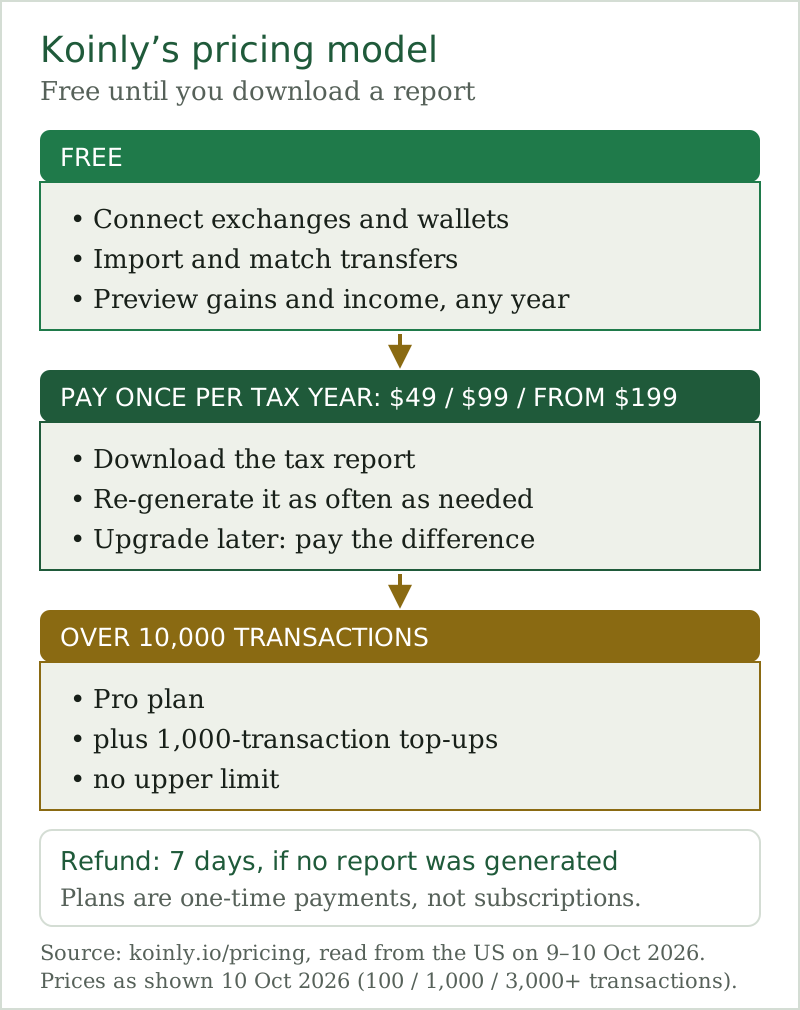
Its pricing page, read from a US connection on 9 and 10 October 2026, says that "every feature is free" and that payment is needed only "for the tax report itself" or once you pass 10,000 transactions. The key terms:
- Free: connecting wallets, importing transactions and previewing your tax summary, with no credit card.
- Paid: the tax report for each tax year you need. Plans are one-time payments, not subscriptions, and Koinly says it will not charge you automatically.
- Large accounts: above 10,000 transactions you take the Pro plan and buy top-ups of 1,000 transactions at a time, with no upper limit; Koinly also offers custom plans for very high volumes.
- Refunds: a full refund within 7 days of purchase if you have not generated a tax report yet.
- Counting: a transaction is any deposit, withdrawal or trade you add. Koinly says it groups related transactions and filters spam, so the count can be lower than your raw history.
The dollar prices sit in the page code rather than its visible text. Read from the US on 10 October 2026, they were $49 per tax year for the Newbie plan (up to 100 transactions), $99 for Hodler (up to 1,000) and from $199 for Trader (3,000 or more), with free tracking up to 10,000 transactions. Prices can change before tax season, so check the figure for your transaction count before you pay. Once you have paid for a tax year, Koinly says you can generate unlimited reports for that year and upgrade by paying the difference.
What it does well
Breadth of imports. Koinly's homepage, read on 9 October 2026, says it connects to "800+ exchanges and wallets," and you can add exchanges by API or CSV and wallets by public address. The more of your history it can read directly, the fewer gaps you fill by hand.
Transfer matching. The homepage says it tracks moves between your own wallets automatically, carrying the original cost basis across. This is the single most important job a tax tool does, because an unmatched transfer can look like a sale with no basis. The IRS confirms that moving crypto between wallets or accounts you own is not a taxable event.
US forms and the 1099-DA. Koinly lists 1099-DA reconciliation and Form 8949 among its outputs, plus TurboTax and FreeTaxUSA exports. That matters now that exchanges send Form 1099-DA with proceeds but often no basis for 2025, and IRS Form 8949 instructions require digital-asset sales to go in the new boxes G to L depending on what was reported.
Cost-basis methods. Its pricing page says it supports FIFO, LIFO, ACB, Shared Pool and HIFO. For US filers, IRS Revenue Procedure 2024-28 requires lots to be tracked per wallet or account from 1 January 2025, with specific identification or FIFO applied within each wallet, so check that your settings reflect that rule and that any non-FIFO choice is supported by your records.
Before-you-pay preview. You can see gains and income across every year and transaction before buying a plan, and Koinly's homepage pitches a tax-loss harvesting view for the current year. For a reader comparing tools, this is the feature that lets you verify everything else in this list.
Where it struggles, and what to double-check
Every automated tool guesses when the data is incomplete, and Koinly is no exception. These are the places to look before you trust a final number:
- DeFi and unusual contracts. Koinly says it handles staking, lending and liquidity activity, but complex or new protocols can be classified in ways you disagree with. Review any DeFi transaction it labels as a sale, income or a transfer.
- Unmatched transfers. A withdrawal from one platform with no matching deposit elsewhere usually means a wallet you have not added. Until you add it, those coins may show missing basis.
- Missing purchase history. Coins bought years ago on a closed exchange may have no import. You will need your own records for those lots.
- Income classification. Staking rewards, airdrops and referral bonuses are income when received. Check that each is tagged as income at its value on receipt, which IRS Revenue Ruling 2023-14 sets for staking rewards.
- Marketing claims. One of Koinly's own homepage answers says that "as of 2026, all centralized exchanges are required to issue Form 1099-DA." The IRS position is narrower: for 2025 the 1099-DA rules generally apply to US brokers, and taxable transactions on foreign platforms must still be reported. Use IRS pages, not a vendor FAQ, for the rules.
Test it yourself: a five-step accuracy check
Because the preview is free, you can check Koinly's output on your own data before you pay. This is the checklist we would use; it needs no special access and takes an evening for a typical year.
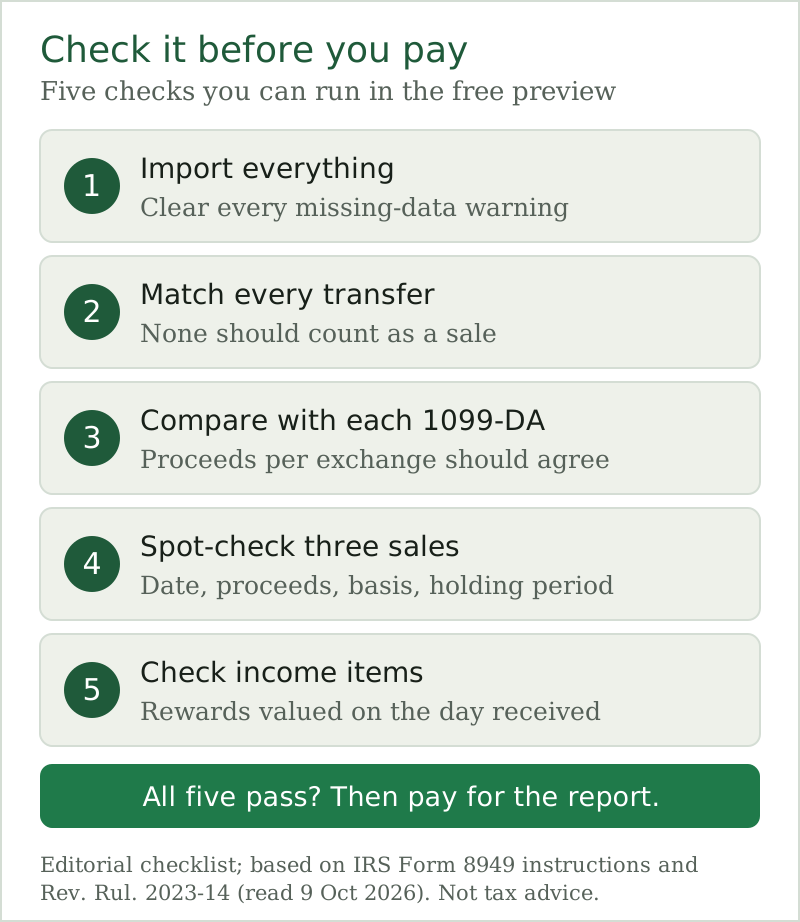
The order matters. Imports come first, because every later number depends on them. Transfer matching comes next, because a transfer left unmatched is the usual cause of a sale with no basis. Comparing each exchange's total proceeds with its Form 1099-DA is the quickest way to catch a missing import or a duplicate. Checking three disposals by hand, including the date, proceeds, cost basis and whether the holding period is over a year, tells you whether the lot method is doing what you expect. Finally, confirm that staking rewards, airdrops and referral bonuses are valued on the day you received them.
If all five look right, the report is probably sound. If not, fix the data first, because paying for a report does not fix a missing wallet.
Countries and reports supported
Koinly's homepage says it is "available in 20+ countries," meaning it produces country-specific tax reports there, while its pricing page says its clients come from more than 140 countries. Those are different claims: the second is where customers are, not where a local report exists. For US filers the outputs that matter are Form 8949, Schedule D and the TurboTax or FreeTaxUSA exports. For UK filers, HMRC's rules on pooling tokens, with same-day and 30-day matching, differ from US lot rules, so confirm Koinly produces the UK report and settings you need. Outside those, check that your exact country and tax year are supported before paying.
It is also worth knowing that Crypto.com retired its own free tax calculator in June 2024 and now points its users to Koinly and TokenTax instead.
Koinly vs CoinLedger vs CoinTracker
These three are the tools most readers compare. The table uses only figures from each vendor's own pricing page, read on 9 and 10 October 2026.
| Koinly | CoinLedger | CoinTracker | |
|---|---|---|---|
| Free tier | All features; pay only to download the report | Free portfolio tracking | Free tracking; no downloadable tax forms |
| How you pay | One-time, per tax year | One-time purchase per tax report | Annual plans |
| Up to about 100 transactions | $49 per tax year (up to 100) | $49 (up to 100) | $59/yr (up to 100) |
| Up to about 1,000 transactions | $99 per tax year (up to 1,000) | $99 (up to 1,000) | $199/yr (up to 1,000) |
| Large accounts | From $199 for 3,000+; above 10,000, Pro plan plus 1,000-transaction top-ups | $199+ for 3,000+, more bought in-app | $599/yr (10,000); $1,999/yr (50,000) |
| Refund terms on pricing page | 7 days if no report generated | Not checked | Not checked |
How to choose: if you file in the US and only want a one-off report, CoinLedger sells one-time reports at the same entry prices as Koinly ($49, $99 and from $199 when we checked), so the deciding factor is which tool imports your exchanges and wallets more cleanly. If you want year-round portfolio tracking in the same app, CoinTracker's annual plans are built for that; it runs no affiliate programme and pays us nothing. If you have activity across many exchanges, wallets or countries and want to verify everything for free before paying, Koinly is the one we would try first. Our crypto tax software rankings cover more tools, including options for complex DeFi.
Affiliate links, marked sponsored/nofollow. We may earn a commission at no cost to you — it never changes a ranking. Check availability, fees and eligibility in your own country first; crypto is volatile and you can lose money.
Is it safe? Data and API keys
Koinly's security page, last revised 19 July 2023, says API and blockchain keys are encrypted with AES-256-GCM before storage, that it does not need private keys or access to your funds, and that it recommends turning off withdrawal and trading permissions when you create exchange API keys. It says data is encrypted in transit, hosted on Heroku, scanned for vulnerabilities by third-party tools, and that payments go through Stripe. Its pricing page displays SOC 2 and ISO 27001 badge images.
The practical rules matter more than the badges. Create read-only API keys, so a leaked key cannot move money. Never type a wallet's recovery phrase into any tax tool; public addresses are all a tracker needs. Use a strong, unique password and two-step login. And remember the trade-off: any service that holds your full history knows a great deal about your finances, so weigh that against the time it saves.
Who Koinly suits, and who should skip it
Koinly suits investors with activity on several exchanges and wallets, people who moved coins around and need transfers matched, and anyone who wants to see the numbers before paying. It is also an option for filers outside the US, in the countries where it produces a local report. Skip it, or at least skip paying for it, if your year was a few trades on one exchange: the exchange's history and a spreadsheet may be enough, as our guide to crypto tax software versus a spreadsheet explains. If you decide to try it, Koinly is a referral link: a purchase may pay this site a fee, with no extra charge to you, and it has no say in this review.
Koinly: quick answers
Is Koinly legit?
How much does Koinly cost?
Is Koinly free?
Does Koinly work with Form 1099-DA?
Koinly or CoinTracker: which is better?
Affiliate link, marked sponsored/nofollow. We may earn a commission at no cost to you — it never changes a ranking. Check availability, fees and eligibility in your own country first; crypto is volatile and you can lose money.
When it is time to file, see the best crypto tax software, ranked on the merits, or start with how crypto is taxed. General information, not tax advice — confirm current rules for your country and consult a professional.