Coinbase Taxes: 1099-DA, Tax Documents and What Coinbase Reports
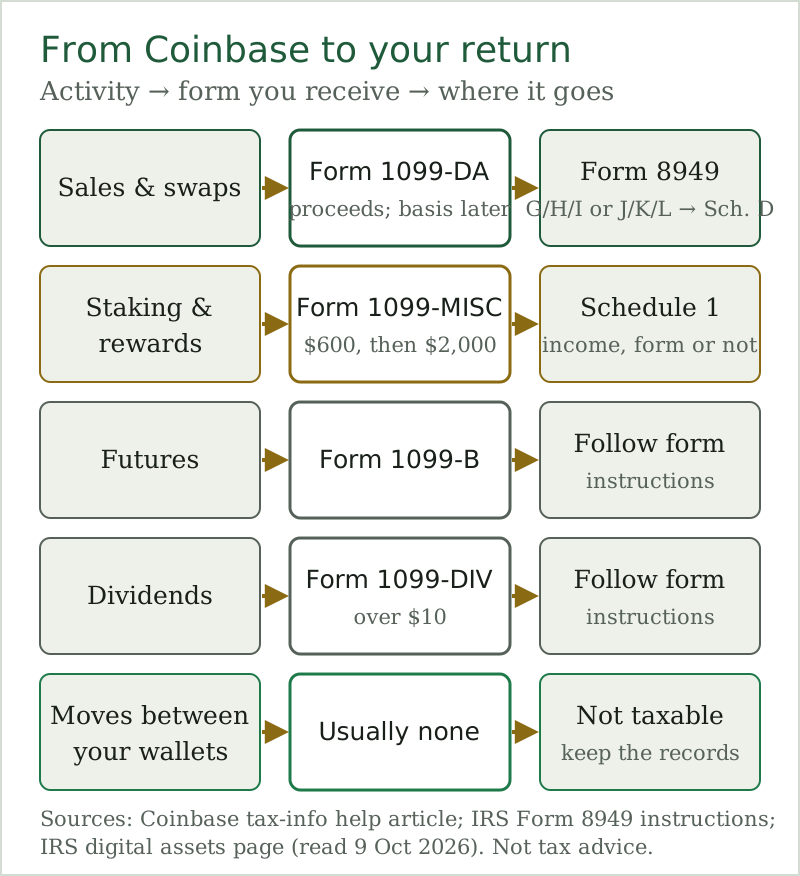
Yes, Coinbase reports to the IRS. For US customers it issues Form 1099-DA for crypto sales and swaps, Form 1099-MISC for rewards and staking income above a threshold, and Form 1099-B or 1099-DIV for futures and dividends, with a copy of each going to the IRS. For the 2025 tax year the 1099-DA shows what you sold for (gross proceeds), not necessarily what you paid, so your own records still decide the gain. You download the forms from Coinbase Taxes at accounts.coinbase.com/taxes. This guide covers the forms year by year, what they leave out and how to reconcile them. It is general information for US taxpayers, based on IRS pages and Coinbase's help centre as read on 9 October 2026, and it is not tax advice; a tax professional who has seen your records is the right person for your specific return.
Short answer: Coinbase reports to the IRS, and here's what you get
Coinbase's tax-information help article, read on 9 October 2026, lists four forms for US customers:
- Form 1099-DA for customers with gross proceeds from sales or exchanges of crypto.
- Form 1099-MISC for customers who earned at least $2,000 in crypto and miscellaneous income, including staking rewards and incentives. The $2,000 figure is the IRS threshold for 2026 payments; for 2025 rewards the federal threshold was $600 (see below).
- Form 1099-B for futures, securities or other financial instruments.
- Form 1099-DIV for more than $10 of dividends.
The IRS gets its own copy of each information return. That is why "does Coinbase report to the IRS?" has a simple answer, and why the more useful question is whether the form is complete. For most people in these first years, it is not, because of how the new rules are phased in.
In the margin: a 1099 is a report, not a bill. You owe tax on your actual gains and income, which may be higher or lower than the form suggests, and you report them whether or not a form arrives.
Forms by tax year: what changed in 2025 and 2026
Form 1099-DA comes from final IRS broker regulations (Treasury Decision 10000, published 9 July 2024). Under them, brokers report gross proceeds for digital-asset sales on or after 1 January 2025, and also report cost basis for certain sales on or after 1 January 2026. The basis requirement applies to "covered" assets: according to the IRS instructions for Form 1099-DA, a digital asset is covered if it was acquired after 2025 in a custodial account and stayed in that account until it was sold.
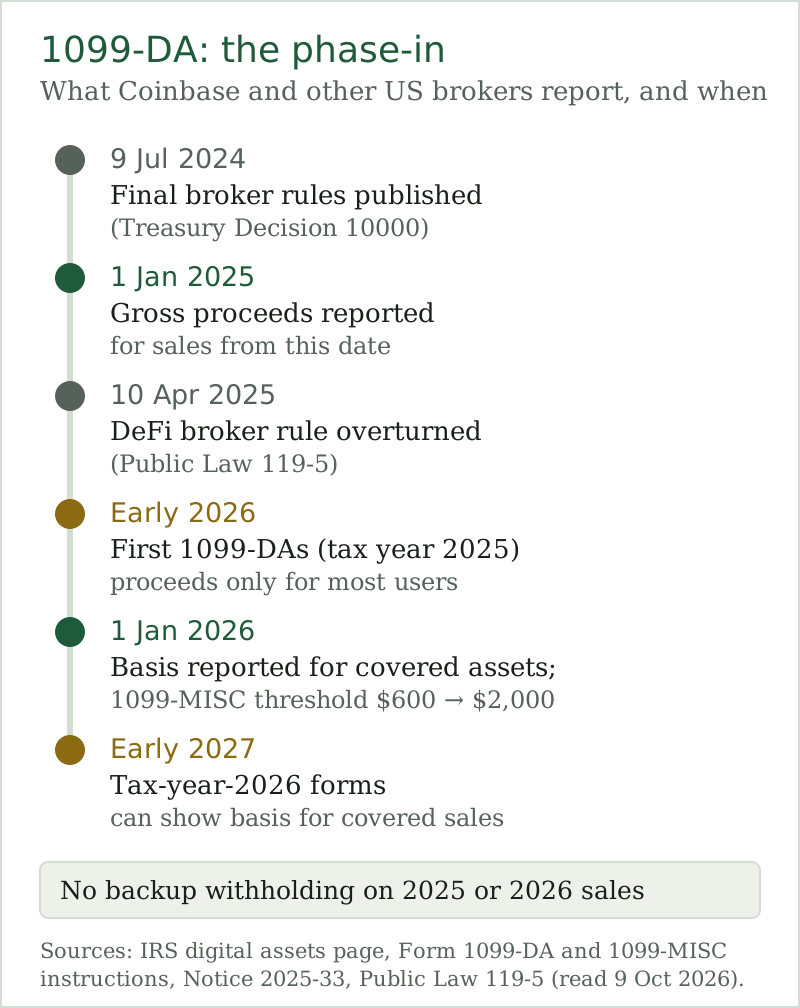
In practice that gives two very different forms:
- Tax year 2025 (filed in 2026): the 1099-DA shows proceeds. Coinbase's help article does not say whether basis appears. Kraken, for comparison, says it reported all 2025 sales to the IRS as noncovered, showing basis only on the customer's copy. Treat any basis on your copy as information, not as a figure the IRS has.
- Tax year 2026 (filed in 2027): for coins bought on Coinbase after 2025 and sold there, the form should carry basis as well. Coins bought earlier, or moved in from another wallet or exchange, are noncovered, so their basis may still be missing.
The 1099-MISC threshold changed too. The IRS instructions for Forms 1099-MISC and 1099-NEC raise the reporting threshold from $600 to $2,000 for payments in tax years beginning after 2025, with inflation adjustments possible from 2027. So 2025 rewards of $600 or more triggered a form; for 2026 rewards the trigger is $2,000. Remember that a threshold only decides whether a form is sent. Staking rewards and other crypto income are taxable whatever the amount; under Revenue Ruling 2023-14, staking rewards count as income at their fair market value when you gain control of them.
Two other transition points are worth knowing. IRS Notice 2025-33 says brokers are not required to apply backup withholding to digital-asset sales made in 2025 or 2026. And the separate rule that would have pulled decentralised (DeFi) front-ends into broker reporting was overturned by Congress and signed into law as Public Law 119-5 on 10 April 2025. Coinbase's custodial exchange is still a broker under the rules; activity in a self-custody wallet generally produces no 1099-DA, though it is still taxable.
How to download your Coinbase tax documents
According to Coinbase's help article, read on 9 October 2026, the route is short:
- Sign in and go to Coinbase Taxes at accounts.coinbase.com/taxes.
- Select Documents.
- Download each form listed for the tax year, plus your transaction history if you plan to reconcile or use tax software.
One change catches people out. Coinbase says that from tax year 2025 onward, Form 8949 is no longer available through the Coinbase retail tax centre. You now build your own Form 8949, by hand or with tax software, using the 1099-DA and your records. Coinbase also says that from tax year 2025 its US trading fees are included in cost basis and subtracted from proceeds, so do not deduct the same fees a second time.
What the 1099-DA misses, and why your numbers won't match
A 1099-DA can only describe what happened inside Coinbase, and in 2025 only part of that. Here is what it typically misses:
- Basis for coins transferred in. If you bought ETH elsewhere in 2023 and moved it to Coinbase, Coinbase does not know what you paid. The sale shows proceeds with no basis.
- Anything outside Coinbase. Self-custody wallets, other exchanges and DeFi activity generate their own taxable events but no Coinbase form.
- Small rewards. Rewards under the 1099-MISC threshold are still income even if no form arrives.
- Your own wallet moves. The IRS virtual-currency FAQ says moving crypto between wallets or accounts you own is not taxable. An exchange cannot always tell a move to your own wallet from a sale or a payment, so the transfer history needs your judgement.
There is also a structural change underneath. Under IRS Revenue Procedure 2024-28, from 1 January 2025 you track basis per wallet or account, not as one pool across everything you own. If your records still use a single "universal" pool, they will not line up with a broker's per-account figures.
Reconciling a 1099-DA with Form 8949: a worked example
Form 8949 now has separate checkboxes for digital assets. According to the IRS instructions for the 2025 form, short-term sales go in box G when a 1099-DA shows basis, box H when it shows no basis, and box I when there was no 1099-DA at all; long-term sales use boxes J, K and L in the same way. Digital-asset sales should not go in boxes C or F.
Take a made-up case. In 2023 you bought ETH on another exchange for $3,200, including fees, and later moved it to Coinbase. In 2025 you sold it on Coinbase for $5,000. Your 2025 Form 1099-DA shows $5,000 of gross proceeds and no basis, because Coinbase never saw the purchase.
- Decide the holding period. Bought in 2023, sold in 2025: more than a year, so it is long-term.
- Pick the box. A 1099-DA with no basis reported, long-term: box K.
- Fill in the line. Proceeds $5,000 (as on the form), basis $3,200 (from your records), gain $1,800.
- Keep the proof. Save the original purchase record and the transfer, in case the IRS asks why your basis differs from a blank on the form.
If you skipped step 3 and left basis at zero, you would be reporting a $5,000 gain instead of $1,800. That is the most common and most expensive mistake with a proceeds-only form. The opposite error matters too: inventing a basis you cannot document leaves you exposed if the return is examined. Our guide to crypto capital gains and tax rates covers how the long-term rate on that $1,800 is worked out.
Reconciling transfers, staking rewards and fees
Most mismatches come from three sources, and each has a standard fix.
Transfers. Match every transfer out of Coinbase with the matching deposit into your other wallet or exchange. Where they match, the move is not taxable and the coins carry their original basis with them. Where you cannot match a transfer, find out what it was: a payment, a gift or a sale elsewhere each has its own treatment.
Staking and rewards. Each reward is income at its value when you received it, and that value becomes the reward's basis for when you later sell it. If you sell reward coins on Coinbase, the 1099-DA shows the proceeds; the basis comes from your income records. Our article on DeFi, staking and airdrop tax goes further.
Fees. Coinbase says its US trading fees are already built into basis and proceeds from 2025. Network fees for moving coins between wallets are a separate question and their treatment depends on the facts, so ask a professional before you deduct them.
Whatever the form shows, you also answer the digital-asset question on page 1 of Form 1040. For 2025 it asks whether at any time during the year you received digital assets as a reward, award or payment, or sold, exchanged or otherwise disposed of them. The IRS instructions say not to leave it unanswered, and that you must answer it whether or not you received a Form 1099-DA.
Using tax software with Coinbase
For one or two sales, a spreadsheet and the 1099-DA are often enough. Once you have transfers in from elsewhere, rewards and more than a handful of trades, matching lots by hand gets slow and error-prone, and since Coinbase no longer produces a Form 8949, software is how most people generate one.
The pattern is the same across tools: connect Coinbase by read-only API key or upload the transaction CSV, add your other wallets and exchanges so transfers can be matched, review anything flagged as unmatched, then export Form 8949 and Schedule D. Koinly says it produces 1099-DA and Form 8949 outputs and can help when a 1099-DA's basis is missing or wrong; it is free to import and preview, and you pay per tax year to download the report. CoinLedger listed one-time reports at $49 (up to 100 transactions), $99 (up to 1,000) and $199 and up (3,000 or more) on 9 October 2026, with free portfolio tracking. ZenLedger is a third US-focused option; check its current plans and integrations before you pay. These are referral links, so a purchase may pay this site a fee at no extra charge to you; that never sets the order or the advice, and our crypto tax software rankings explain how we compare them.
If you never got a Coinbase tax form
Not receiving a form does not mean you have nothing to report. You may simply have been under a threshold, or your activity may not trigger a form at all, such as buying and holding without selling. Check Coinbase Taxes, download your transaction history, and list every sale, swap and spend and every reward you received. Report taxable events on Form 8949 (box I or L when there is no 1099-DA) and income on Schedule 1, and answer the digital-asset question honestly.
The IRS also notes that for 2025 the 1099-DA filing rules generally apply to US brokers, but taxable transactions on foreign platforms must still be reported. If you think you missed crypto on an earlier return, our guide on what happens if you don't report crypto tax explains the options, and a tax professional can advise on amending.
Coinbase taxes: quick answers
Does Coinbase report to the IRS?
Where do I find my Coinbase tax documents?
Why does my Coinbase 1099-DA have no cost basis?
Does Coinbase send a 1099 for staking rewards?
Do I have to report Coinbase crypto if I didn't sell?
When it is time to file, see the best crypto tax software, ranked on the merits, or start with how crypto is taxed. General information, not tax advice — confirm current rules for your country and consult a professional.