How to Report Crypto on Taxes in TurboTax or by Hand: Form 8949, Line by Line
How to report crypto on taxes, in TurboTax or by hand, comes down to three places on a US return. Answer the digital-asset Yes/No question on page 1 of Form 1040; list each sale, swap or spend on Form 8949, using the new digital-asset boxes G to L; and carry the totals to Schedule D. Crypto you earned, such as staking rewards, goes on Schedule 1 as income instead. TurboTax fills in the same forms from what you import or type, so knowing where each number belongs is what lets you check its work.
This walkthrough covers the 2025 tax year, the first with Form 1099-DA, and flags what changes for 2026. It uses a sample Form 8949 with invented numbers so you can see every column filled in. It is general information from IRS forms and instructions read on 9 October 2026, plus TurboTax's own help pages, not tax advice; if your year included mining as a business, large DeFi activity or anything you are unsure about, a tax professional is worth the fee.
Short answer: the forms that carry crypto
The IRS treats digital assets as property, not currency, so selling, swapping or spending them works like selling any other asset: you report a capital gain or loss. The IRS digital-assets page says gains and losses go on Form 8949, Sales and Other Dispositions of Capital Assets, and that income from staking, mining and similar activity is generally reported on Schedule 1 of Form 1040. Mining or staking run as a business may belong on Schedule C instead.
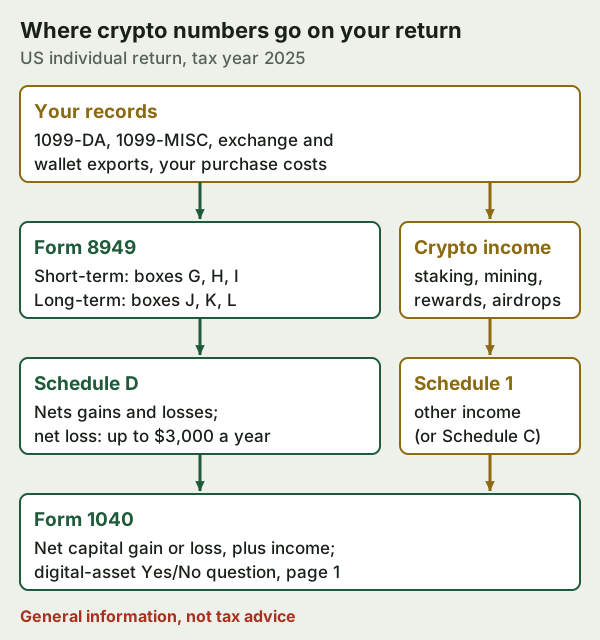
Read the chart from left to right. Your records produce lines on Form 8949. Form 8949 produces totals for Schedule D. Schedule D produces one net figure for Form 1040. Income from crypto skips that chain entirely and goes through Schedule 1. If you only bought and held, none of the middle steps apply, but the question on Form 1040 still does.
Step 1: the Yes/No digital-asset question on Form 1040
Every individual return asks it, whether or not you got a Form 1099-DA. For 2025 the exact wording is: 'At any time during 2025, did you: (a) receive (as a reward, award, or payment for property or services); or (b) sell, exchange, or otherwise dispose of a digital asset (or a financial interest in a digital asset)?' The Form 1040 instructions say not to leave it unanswered.
Tick Yes if you sold crypto for dollars, swapped one coin for another, paid for something with crypto, or received crypto as pay, a reward, staking income or an airdrop. Tick No if all you did was hold, buy with dollars, or move coins between wallets and accounts you own. Those transfers are not taxable even if a platform sends you an information return about them, according to the IRS virtual-currency FAQ.
The question is not a confession. Answering Yes simply tells the IRS to expect the forms that follow. Answering No when the true answer is Yes is the mistake that causes trouble; our page on what happens if you don't report crypto covers the consequences.
Step 2: gather your records, including any 1099-DA
For sales in 2025, US crypto brokers had to report gross proceeds on the new Form 1099-DA, and reporting of cost basis begins only for certain transactions from 1 January 2026. In practice, most 2025 forms show what you sold for, not what you paid. You must work out basis yourself before you file, the IRS says, and taxable trades on foreign platforms still have to be reported even though those platforms are generally outside the 2025 form rules. Our guide to Form 1099-DA explains the form box by box.
Collect four things for each account and wallet you used during the year. First, every Form 1099-DA and Form 1099-MISC you received. Second, the full transaction history export from each exchange, not just the tax summary. Third, records of anything bought before 2025 that you sold in 2025, since that purchase price is your basis. Fourth, wallet histories for anything done outside an exchange, such as swaps in a self-custody wallet.
Two rules shape how you match purchases to sales. From 1 January 2025, Revenue Procedure 2024-28 requires basis to be tracked wallet by wallet, or account by account, rather than across everything you own; within each wallet you use specific identification or first-in, first-out. And if you moved coins between your own accounts, the move itself is not a sale, but the receiving exchange will not know what you paid, which is why transferred-in coins often appear without basis.
Step 3: fill in Form 8949, with a sample
The 2025 Form 8949 adds six boxes just for digital assets, and the instructions say not to put digital-asset sales in boxes C or F any more. You tick one box per page, so sales that fall in different boxes go on separate pages. Short-term sales, for assets held one year or less, go in Part I; long-term sales go in Part II.
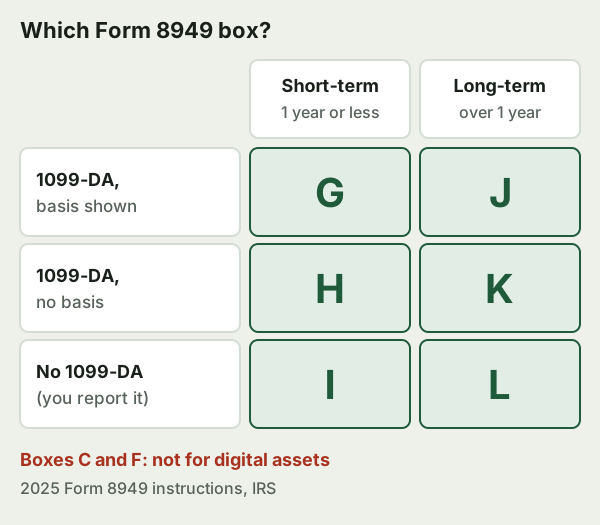
Here is a sample filled in for one person's 2025 sales. Every figure below is invented for illustration; none is a historical price, and your own lines will differ. Purchase costs include trading fees, which reduce your gain, and sale proceeds are after fees.
| Box | (a) Description | (b) Acquired | (c) Sold | (d) Proceeds | (e) Basis | (h) Gain or (loss) |
|---|---|---|---|---|---|---|
| H | 0.05 BTC (sale tx ID) | 03/03/2025 | 11/18/2025 | $4,650 | $4,300 | $350 |
| I | 40 SOL (swapped for ETH in own wallet) | 02/01/2025 | 06/05/2025 | $6,200 | $9,000 | ($2,800) |
| K | 2 ETH | 01/10/2024 | 08/22/2025 | $8,600 | $5,200 | $3,400 |
Walk through each line. The bitcoin sale appeared on the exchange's 1099-DA with proceeds of $4,650 but no basis, so it goes in box H, and the $4,300 basis comes from the person's own purchase record. The SOL-for-ETH swap happened in a self-custody wallet, so no broker reported it: box I, with proceeds equal to the dollar value of the ETH received at the time of the swap. The ether was held for more than a year before selling, so it is long-term, and with proceeds-only reporting it lands in box K.
Columns (f) and (g) are for adjustment codes and amounts, which you need when a 1099-DA figure is wrong or when another special rule applies; the Form 8949 instructions list the codes. For each digital asset, column (a) should give the asset's name or symbol, the exact units disposed of and, where available, the sale transaction ID. If you have hundreds of lines, Exception 2 in the instructions (read 12 Oct 2026) lets you attach statements carrying the same columns instead of filling row after row, which is what crypto tax software produces.
Step 4: carry the totals to Schedule D
Each Form 8949 page ends with totals for proceeds, basis, adjustments and gain or loss. Schedule D gathers those totals, short-term in Part I and long-term in Part II, and the Schedule D instructions tell you which line each 8949 box feeds. In the sample, the short-term pages net to a $2,450 loss (a $350 gain less the $2,800 loss) and the long-term page shows a $3,400 gain.
Schedule D then combines the two parts. Here the short-term loss offsets most of the long-term gain, leaving a net capital gain of $950. Because the long-term gain is larger than the short-term loss, that $950 is treated as long-term and taxed at the 0%, 15% or 20% rates rather than as ordinary income; our page on crypto capital gains rates shows where the bracket thresholds sit.
Had the result been a net loss instead, IRS Topic 409 allows up to $3,000 of it ($1,500 for married filing separately) to be set against other income each year, with any excess rolling into future years. Our guide to crypto losses and tax-loss harvesting covers how to use that carryforward.
Income items: staking, mining, airdrops and rewards
Crypto you receive as income is taxed when you receive it, not when you sell. Revenue Ruling 2023-14 says staking rewards count as gross income, valued at what they were worth at the moment you gain control of them, and the same applies when you stake through an exchange. Mining rewards, airdrops, and crypto received for work or as a bonus follow the same logic. For most individuals that income goes on Schedule 1 as other income; run as a business, it may belong on Schedule C instead.
In the sample year, suppose the person also received ether staking rewards worth $1,050 in total at the moments they arrived. That $1,050 is income on Schedule 1, and it becomes the basis of those coins, so a later sale only taxes any rise above it. Keep a dated record of every reward, because exchanges report them inconsistently. For 2025 rewards, platforms sent Form 1099-MISC when they paid $600 or more; for 2026 the threshold rises to $2,000. Below the threshold you may get no form, but the income is still reportable. Our staking, DeFi and airdrop tax guide goes deeper.
Doing it in TurboTax, or with software
TurboTax's help article on entering crypto, last updated 30 April 2026, describes three routes. In TurboTax Online you can import directly from a supported exchange, which TurboTax recommends; upload a gain-and-loss report as a PDF or as a JPG, JPEG or PNG image; or type transactions in yourself. TurboTax Desktop does not offer the direct import: you upload a TXF file or enter transactions manually, and TurboTax suggests converting a CSV to TXF with a third-party tool first. Its tips page also lists stock sales, including crypto investments, among the situations its Free Edition does not cover, so expect to need a paid edition.
Whichever route you use, check the result against the steps above. Make sure the digital-asset question shows Yes when it should, that imported lines landed in boxes G to L rather than the stock boxes, and that coins transferred in from another wallet carry your real basis rather than zero. A proceeds-only 1099-DA imported without basis can make a modest gain look like the whole sale price.
With more than a few dozen trades, crypto tax software does the matching for you and produces Form 8949 lines plus a report you can upload. Koinly lets you connect wallets and preview your tax summary free, and charges per tax year for the report, from $49 for up to 100 transactions as listed on 10 October 2026; see Koinly's plans. CoinLedger's portfolio tracking is free, with reports from $49 for up to 100 transactions as listed on 9 October 2026; see CoinLedger. ZenLedger is another option. These are affiliate links, so we may be paid if you buy; our ranking of crypto tax software explains how we compare them.
Who can help you file, and the do-it-yourself path
If your year was a few exchange trades with a 1099-DA, the manual route above is realistic: one 8949 page per box, a Schedule D, and the Form 1040 question. Our comparison of tax software and spreadsheets helps you decide when a spreadsheet stops being enough.
If you mined or staked at scale, used DeFi lending or liquidity pools, have years of unreported activity, or received a letter from the IRS, pay for help. Look for a CPA or an IRS enrolled agent who works with crypto clients, and ask how they handle missing basis before you hire them. Software can organise the records, but it cannot argue your case if a return is examined.
Edge cases that change the paperwork
A handful of situations come up often enough to plan for. None changes the basic route above, but each changes a line or a box.
- Transferred-in coins. A 1099-DA may show proceeds with no basis for coins you bought elsewhere. Use box H or K and enter your documented basis; moving coins between your own wallets was not itself taxable.
- Stablecoin sales. Brokers may skip reporting qualifying stablecoin sales if your total proceeds from them stay at or below $10,000 for the year. You still report any gain or loss, though for a stablecoin it is usually tiny.
- Fees inside basis. Coinbase says it includes US trading fees in cost basis and subtracts them from proceeds from tax year 2025, and it no longer provides a Form 8949, so you or your software build that form from the 1099-DA.
- Covered from 2026. Coins acquired from 1 January 2026 inside a custodial account, and sold without leaving it, are covered, so the 2026 1099-DA should show their basis and they go in box G or J.
- Basis already reported, nothing to fix. Where a 1099-DA shows basis was reported to the IRS and no adjustment is needed, the Form 8949 instructions (Exception 1, read 12 Oct 2026) let you enter those totals directly on Schedule D line 1a or 8a and skip Form 8949 for them. Expect this to matter more once covered sales show basis.
Reporting crypto on your taxes: quick answers
How do I report crypto on my taxes in TurboTax?
Do you have to report crypto on taxes if you didn't sell?
Which crypto tax forms do I need?
What is the crypto tax form 8949 box for a 1099-DA?
Who can help me file crypto taxes?
When it is time to file, see the best crypto tax software, ranked on the merits, or start with how crypto is taxed. General information, not tax advice — confirm current rules for your country and consult a professional.